
The new equation between 'Namo' and 'Barack' may well 'convert a good start into lasting progress.'
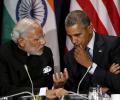
'Big countries do not agree on every set of issues.' 'Look, one of the differences in the relationship is that when we do not agree, we are sitting down and talking to each other.'

'I could see it not having any impact whatsoever,' says Stephen P Cohen on Obama's India visit.
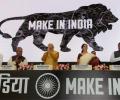
'India is going to maintain its ties to China, India is going to develop a strong relationship with the United States. It means that India is going to have the flexibility to pick and choose its friends.' 'That's traditional Indian foreign policy, and it's smart.' Former US ambassador to India Frank Wisner, one of America's sharpest minds on South Asia, tells Aziz Haniffa/Rediff.com what Washington can expect from Narendra Modi's visit.

'The success or otherwise of Modi's foreign policy will largely depend on the equation he is likely to strike with Donald Trump.'

'Modi's promise of change during the election campaign was on the domestic front, but his first year in office focused on foreign policy beyond all expectations,' says Ambassador T P Sreenivasan.

"What is the need for such a legislation if the public sector and the government will be the only nuclear operators? What is the purpose of this law or of putting a cap on compensation if it is the government which has to pay?" a senior BJP MP said.The BJP fears that once this Bill is passed the government may allow private players later by effecting an amendment only regarding entry of private operators while leaving the Rs 500 crore compensation cap intact.

'Just how strong were the ties between the world's largest and oldest democracies that an incident involving a diplomat and a maid led to anger threatening the relationship itself? Or had the relationship been weakening in the past few years, masked by the empty symbolism of State dinners, asks Devesh Kapur.

The city readies itself for the biggest economic, political and social event of the year
A group of Non-Governmental Organisation and social activists on Monday approached the Supreme Court seeking a direction to make it binding on the Russian company involved in setting up of the controversial Kudankulam nuclear power plant to pay damages in case of an incident.
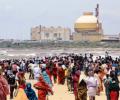
How on earth did Dr Manmohan Singh and his ministers conclude that the casualties of a disaster in a nuclear plant would be fewer than the deaths and injuries caused by the Bhopal gas tragedy? And that the compensation could, therefore, be capped at a smaller amount, asks T V R Shenoy.

'What is the ISI doing and why can't they understand for their own interest that bringing stability to the region will help all the countries become prosperous, whereas a continuation of incitement will only lead to misery for all.'
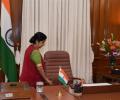
Sushma Swaraj, like Clinton, has a strong political base in her own party and is likely to have her imprint on foreign policy, says Ambassador T P Sreenivasan.

'The question remains: Was the Obama visit truly a success? Only the future will tell us if the "breakthrough" in the nuclear liability issue will concretise into electricity.' 'As importantly, it will be interesting to watch how India's relations with China will evolve in the months to come.'

'Of all the areas that define the future for a strong US-India partnership, none is more important than our defence and security ties.'
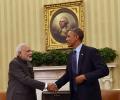
Furthering Indo-US cooperation on terrorism, Prime Minister Narendra Modi and President Barack Obama on Tuesday agreed to make "joint and concerted efforts" to dismantle safe havens for terror and criminal networks like Lashkar-e-Tayib, Jaish-e-Mohammad, Dawood-company, Al Qaeda and the Haqqani network.
Anti-nuclear activist S P Udayakumar, who has been called a threat to the economic security of India by the Intelligence Bureau, speaks to A Ganesh Nadar.

He had come in search of jobs in America to rescue his presidency and India failed him in more ways than one, observes Ambassador T P Sreenivasan.
At no other time has a single meeting of the leaders of two democracies been so critical and hazardous.
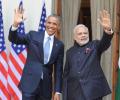
Modi and Obama surely put India-US ties in fast-forward mode. But 5 things deserve careful attention.

'Devyani -- she is a public servant and her personal life has already received far too much attention -- and her ambitious father now need to retreat to the background so that wiser diplomatic heads restore sanity to India-US relations as India prepares for parliamentary elections,' says Ambassador K C Singh.

Obama's decision to visit India must be a result of his judgement that Modi is a man of action, feels Ambassador T P Sreenivasan.

PM Modi seems to be gradually ending India's strategic ambiguity

Diplomats agree that amid stormy relations with China and Pakistan, Modi has posted impressive foreign policy successes, notes Aditi Phadnis.

'It is in the interest of both sides that the visit of the US President is seen as being successful. Both sides have invested considerable political capital in it. This rapid exchange of visits and the decisions taken have to be justified, beyond the symbolism, which is no doubt important in itself. This opportunity to impart a fresh momentum to ties should not be missed,' says former foreign secretary Kanwal Sibal.
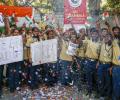
Experts said India has possessed the anti-missile technology for several years but needed the political go-ahead to actually test it in live conditions.

Nobody bothered to articulate the upsides; instead, the four-year tour of duty and denial of life-long pensions got played up.
Job-seekers for government and related opportunities found that their future was at risk, points out Shreekant Sambrani.

Ashley J Tellis, a leading authority on Indo-US relations, tells Archis Mohan in an emailed interview that it is time Washington and New Delhi agreed on the contours of their 'strategic partnership', and that India's elite could learn from Prime Minister Narendra Modi in how he has put India's interests first and his own sentiments about the Americans second.

There is a vocal constituency of educated, well-to-do, articulate Indian elites who would rather go with the idea that too much democracy is a liability. That India needs a spell of benevolent dictatorship. Of course, they have never lived under one, points out Shekhar Gupta.
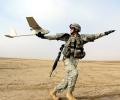
'As the tanks roll down Delhi's Rajpath and the C-17s fly overhead, there could be a lot brewing in Hyderabad House,' says Surya Gangadharan.
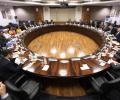
'India appears to have stood its ground on strategic autonomy by resisting US pressure on Russia, China and Iran, but succumbed to the temptation to walk into a tighter embrace in defence cooperation, a high priority of the Trump administration,' notes Ambassador T P Sreenivasan.
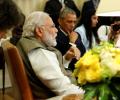
Seeking to boost the strategic ties, India and the US finalised the text of the Logistics Exchange Memorandum of Agreement.

Any unexpected expense can disturb the finely-balanced budget of middle-class individual. That's when a motor insurance policy comes as a saviour
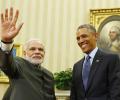
When President Obama lands in New Delhi later this week, this spirit of accommodation must reignite a strategic economic relationship between the two countries.

'It is vital we should form an international coalition against ISIS, because their brutality and the use of the Internet for jihadist activities is a reminder that the entire world community has to be in this together,' US Congressman Ed Royce, chairman of the House Foreign Affairs Committee, tells Aziz Haniffa/Rediff.com in an exclusive interview ahead of Prime Minister Modi's visit.

'Notwithstanding the realisation among the Indian leadership to build up its navy for the force's expanding role, the Indian Navy was allocated only 15% of the interim defence budget presented in Parliament in February 2019.' 'The outlay for the navy's capital acquisition is not even adequate to meet its committed liabilities,' points out Brigadier S K Chatterji (retd).

'By the time he came out after nearly five hours, he had a one-to-one conversation with the President, a delegation-level meeting, a reception, a dinner, a tour of the White House and a joint statement of a kind none of his predecessors ever had,' says Ambassador T P Sreenivasan.

The joint statement issued after Prime Minister Narendra Modi and President Barack Obama's first-ever summit is high on intent and ambition. Notably missing from the statement is India's refusal to be America's partner in its war against ISIS.

'I believe one of the most critical issues is the common threat we face from Islamist radicals and the continuing and unimpaired financing of Al Qaeda, the 'D' Company, the Haqqani network, the LeT and the Jaish-e-Muhammed.'
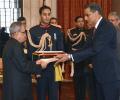
'India is part of our strategic and economic future,' says Richard Rahul Verma, the first Indian American to be appointed US Ambassador to India.
